
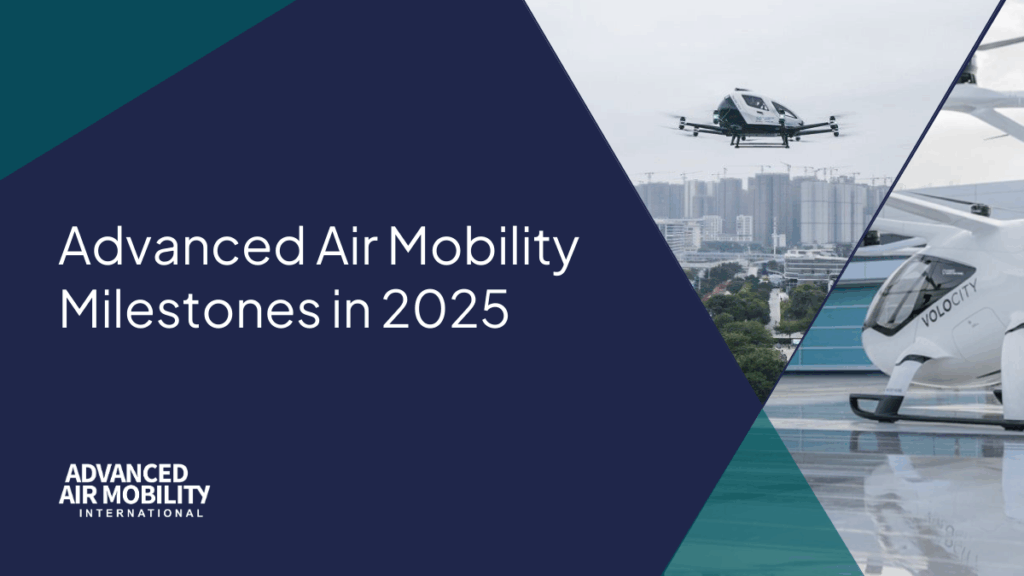
2025 marked a watershed period for Advanced Air Mobility (AAM), as the industry moved decisively from concept toward real-world deployment.
Across the globe, regulatory frameworks matured, pilot-in-command certifications expanded, and public-private partnerships secured major funding rounds. eVTOL developers conducted full-scale flight demonstrations, while urban infrastructure projects began ground-work for vertiport networks.
From battery advances to quieter propulsion systems, technical progress accelerated, setting the stage for commercial operations.
This roundup captures the most significant milestones of 2025, highlighting where AAM took concrete steps toward becoming a viable, integrated transportation solution.
Contracts, Funding & Partnerships
There was unprecedented investment in AAM in 2025, with major funding rounds, government-backed contracts, and strategic partnerships accelerating aircraft development and infrastructure deployment. Key players secured capital to scale manufacturing, while collaborations across aerospace, telecom, and energy sectors solidified the ecosystem required for commercial AAM operations.
Doroni Aerospace secured a $30 million strategic investment to accelerate the development, certification, and production of its H1-X eVTOL aircraft. The funding, provided by Innovation Wings Industries (IWI), operating as Kingdom Aero Industries (KAI), is expected to enable Doroni to push forward with its ambitious plan to launch the aircraft by the end of 2026.
Eve Air Mobility was selected in a public call by Brazil’s FINEP to receive a grant of up to $15.8 million for sustainable urban air mobility solutions.


Sarla Aviation successfully raised $10 million in Series A1 funding to accelerate the development of advanced eVTOL technology.
Diamond Aircraft Industries acquired Volocopter. Volocopter is expected to benefit from Diamond’s extensive manufacturing expertise, helping to streamline operations, reduce costs, and accelerate certification efforts.
ASKA has been working with East Japan Railway Company (JR East) to explore the possibilities of implementing the ASKA A5 roadable electric-hybrid VTOL aircraft in society, while aiming to realize sustainable urban development and tourism services using flying cars.


Flight Demonstrations & Testing
AAM developers advanced beyond prototypes in 2025, achieving more frequent full-scale test flights, expanded certification campaigns, and increasingly complex mission profiles. Demonstrations validated aerodynamic performance, autonomy, and noise levels, proving readiness for urban operations and helping regulators define pathways toward type certification and early commercial services.

Benidorm, Spain, hosted Europe’s first real-world demonstration of simultaneous flight between an air taxi and drones in an urban environment. The demonstration was part of the European U-ELCOME project, which focuses on integrating air traffic management for drones through the U-space system.
Vertical Aerospace completed the first piloted wingborne flight of a winged eVTOL aircraft in open airspace.

Alef Aeronautics, a sustainable mobility company designing and developing a flying car, conducted a flight test of its flying car in a city environment.
Joby Aviation entered the final phase of certification for its electric air taxi, having conducted its first Federal Aviation Administration (FAA) testing under Type Inspection Authorization (TIA).
Infrastructure Developments
Significant strides were made in establishing the physical and digital backbone for AAM in 2025. Vertiport construction, airspace integration systems, and charging networks progressed from planning to implementation, while cities and aviation authorities collaborated on standards. These developments laid essential groundwork for scalable, safe passenger and cargo eVTOL operations.
Skyports Infrastructure and LODD, an AI-powered drone technology and autonomous aerial logistics specialist, unveiled vertiport designs to be developed across three strategic locations in Abu Dhabi.
The FFLIP project led by Petalite successfully demonstrated high-power, multi-modal charging infrastructure for future electric aircraft, drones, and ground vehicles.


Skyportz unveiled an animation of its award-winning patent, designed to ameliorate downwash and outwash, created by Vertiport Simulations for the Paris Airshow.
Special Mentions

LEO Flight Corporation virtually debuted its LEO Solo single-seat recreational eVTOL vehicle at CES 2025 (Consumer Electronics Show) with support from the Indiana Economic Development Corporation (IEDC), spotlighting Indiana’s commitment to innovation and leadership in the future of mobility.
Joby Aviation prepared for final assembly of its first conforming aircraft designed for Type Inspection Authorization (TIA) flight tests.

RICTOR made its debut at at CES 2025 in Las Vegas with solutions centered around the theme of “Future Mobility.” RICTOR displayed the Skyrider X1 flying motorcycle, the company’s latest breakthrough in the eVTOL field.
Look out for our next feature, “What is the Future of Advanced Air Mobility in 2026,” to explore how evolving technologies, regulations, and commercial rollouts will shape the next chapter of AAM’s global transformation.