
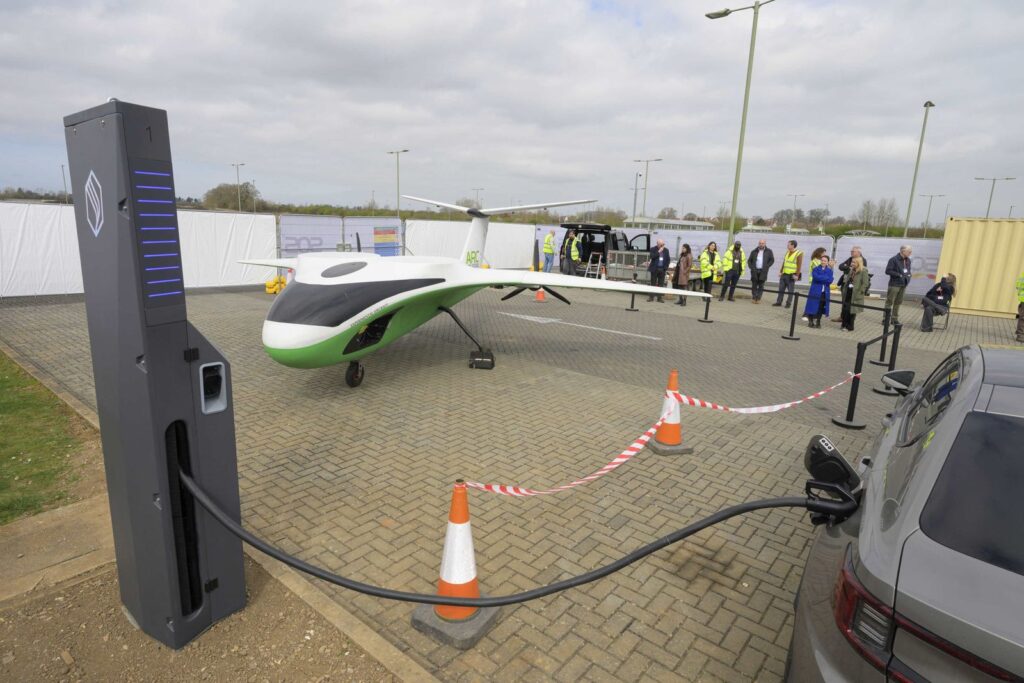
A project led by Petalite saw the successful demonstration of the Future Flight and Land Infrastructure Programme (FFLIP), designed to power the next generation of electric vertical landing (eVTOL) aircraft, drones, and EVs in Bicester, Oxfordshire.
Project Objectives
The FFLIP project aimed to develop technology within each consortium member organisation to support the high-power demands of future electric aircraft and airport infrastructure. The focus was on achieving design performance targets, meeting sustainability objectives, and aligning with end-user requirements.
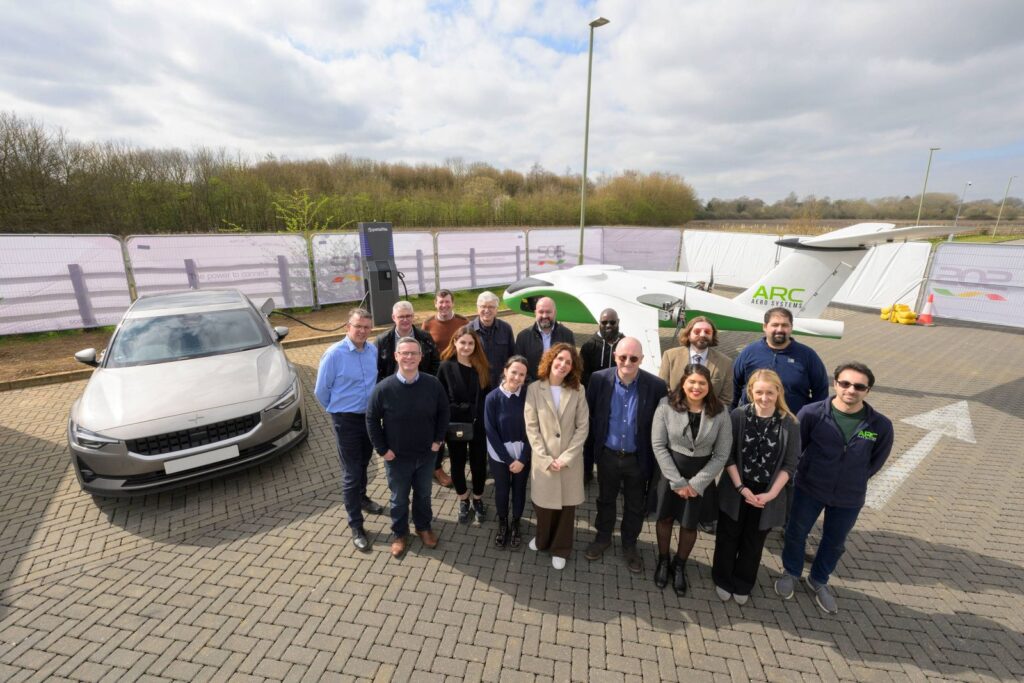
At its conclusion, FFLIP delivered a full-scale, multi-modal demonstration integrating various forms of transport at a site in Oxfordshire. The goal was to validate a 600kW charging infrastructure with multiple power configurations, capable of supporting the rapid, continuous charging of electric ground vehicles, trucks, drones, and eVTOL aircraft.
The Challenge
eVTOLs require ultra-rapid, high-capacity charging to support continuous operation. The main challenge was developing a 600kW solution that balances performance with grid stability and energy efficiency, particularly in urban environments. Petalite addressed this through its intelligent, load-managed charging technology.
Petalite’s Role
Petalite’s technology is well suited to the demands of eVTOLs, offering the reliability, scalability, and availability required. Its patented Sinusoidal Direct Current (SDC) technology, built from the ground up, simplifies power supply design, enhances modularity, and delivers high reliability. In the event of a power supply failure, the system experiences only a fractional loss in output. This approach removes the limitations of existing voltage source topologies found in current market solutions.
Over the course of the project, Petalite increased the power density of its PowerCore from 12kW to 20kW, improving both size and cost-efficiency. Additionally, the transition from air to liquid cooling enhanced efficiency and longevity while reducing maintenance requirements.

In parallel, the team developed a prototype charge post and power hub with a focus on user experience. Features such as active cable management ensure ease of use while maintaining high performance. Throughout the project, Petalite met all technology milestones, advancing its Manufacturing Readiness Level (MRL) to 6 and Technical Readiness Level (TRL) to 7.
A Step Closer to Advanced Air Mobility (AAM)
As part of the project’s conclusion, Petalite’s prototype DC charge post and power hub successfully charged an electric vehicle and a drone simultaneously. This demonstration validated the contributions of all consortium members and proved the viability of high-power, multi-modal charging infrastructure.
The demonstration site in Oxfordshire offered an ideal environment to showcase Petalite’s technology in real-world conditions. Within the available grid capacity, the system performed as intended, supporting simultaneous charging of both an EV and a drone. This practical test confirmed the feasibility of 600kW charging infrastructure with flexible power configurations, designed for continuous operation.
Consortium Members & Their Roles
- Petalite – Developed and tested a rapid charging solution for eVTOL and EV infrastructure.
- Oxfordshire County Council (OCC) – Provided the demonstration site and power supply, supporting the transition to zero-emission transport.
- Midlands Aerospace Alliance (MAA) – Ensured aerospace safety compliance and worked with the Civil Aviation Authority (CAA) to shape eVTOL charging regulations.
- ARC Aerosystems – Supplied eVTOL prototypes for real-world testing.
- SOS Synergy – Designed and installed the electrical infrastructure to support Petalite’s prototype DC charge post and power hub, managed the associated civil engineering, and oversaw the overall demonstration site.
This demonstration marks a significant step forward in the development of charging infrastructure needed to support advanced air mobility in the UK. Projects like FFLIP offer a glimpse into the future and help explore the potential of high-power, scalable charging solutions capable of enabling autonomous air logistics, air taxis, and next-generation aviation.
Petalite’s CTO, Robert Nash, stated, “This project marks a significant milestone for Petalite, proving our technology in a real-world setting. Successfully demonstrating our prototype charger and power hub in the field brings us one step closer to revolutionising high-power EV and eVTOL charging. The team’s dedication and innovation have been instrumental in making this possible.”