
Integrating proprietary hybrid-electric propulsion technology with a lift-plus-cruise architecture, the Atea eVTOL from Ascendance offers a low-carbon, efficient alternative to conventional helicopters while ensuring operational versatility across various mission profiles.
The aircraft is engineered for short-haul routes of up to 250 miles, targeting applications such as passenger transport, medical evacuation, logistics, and surveillance.
Atea eVTOL Design
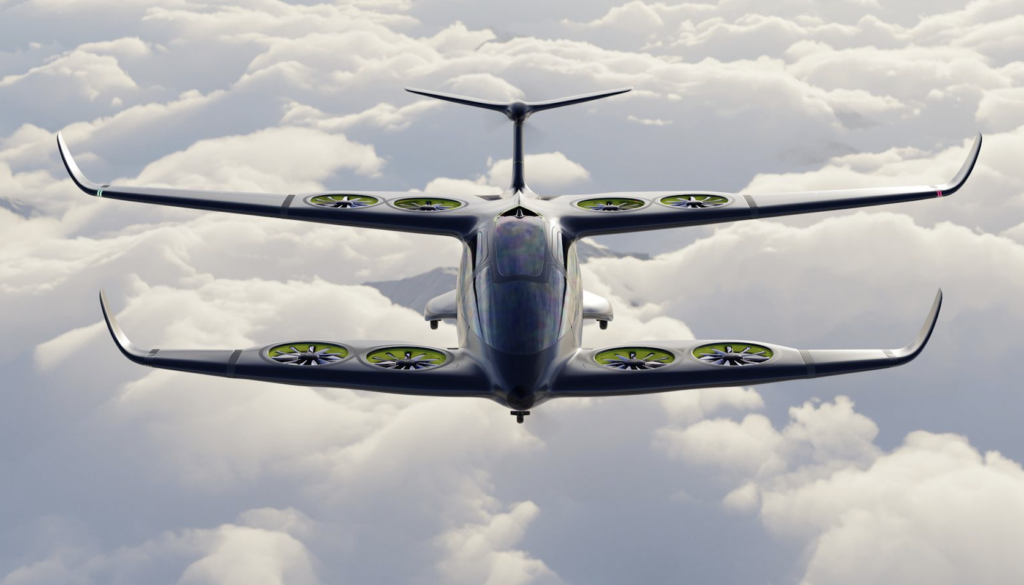
Atea features a sleek, fixed-wing configuration with a high-mounted wing and V-tail, optimized for aerodynamic efficiency and stability during forward flight. The aircraft uses a lift-plus-cruise architecture, incorporating eight vertical lift fans integrated into fixed ducts in the wings for VTOL capabilities, while a rear-mounted pusher propeller drives horizontal cruise flight. This separation of lift and thrust functions simplifies flight dynamics and improves safety and redundancy.
The cabin is designed to accommodate a pilot and four passengers, with a spacious interior and panoramic windows to enhance the onboard experience. The airframe is built using lightweight composite materials, contributing to both structural efficiency and reduced environmental impact.
Features of the Atea eVTOL
Atea is powered by Sterna, Ascendance’s proprietary hybrid-electric propulsion system. This modular system combines a turbogenerator with battery packs to provide optimal energy efficiency and fuel flexibility, reducing carbon emissions by up to 80% compared to conventional rotorcraft. This approach enables the aircraft to operate independently of charging infrastructure, significantly increasing its mission readiness and range.
The aircraft includes safety features such as distributed electric propulsion for redundancy, simplified mechanical systems, and advanced avionics to support semi-autonomous operations. Its compact footprint and quiet operation—up to four times quieter than a traditional helicopter—make it well-suited for operations in urban environments, helipads, and sensitive areas.
Atea eVTOL Performance
Atea is engineered for missions up to 400 kilometers (approximately 250 miles), with a maximum cruise speed of 200 km/h (124 mph). The hybrid propulsion system enables continuous operations with minimal downtime and accommodates frequent vertical takeoffs and landings without compromising energy efficiency.
The aircraft’s ability to operate from constrained landing zones with minimal infrastructure requirements enhances its adaptability for a wide range of missions, from urban air mobility to rural medical evacuation and border surveillance.
Atea Capabilities
The combination of lift-plus-cruise configuration and hybrid-electric propulsion gives Atea a unique position in the AAM sector. Its design reduces operational costs and maintenance requirements while increasing mission flexibility. With scalable powertrain architecture and a certification roadmap aligned with EASA standards, Atea is poised to support the transition to cleaner aviation without the infrastructure constraints that limit fully electric VTOL platforms.
Ascendance Flight Technologies plans to enter service by 2027, with Atea representing a significant step forward in the commercialization of sustainable advanced air mobility solutions.