

A consortium of industry partners, including SkyDrive, and local authorities in Osaka has launched a feasibility study to evaluate converting existing rooftop emergency landing sites into alternate vertiports for electric vertical takeoff and landing aircraft.
Conducted under the Cabinet Office’s Super City Initiative, the project brings together compact aircraft developer SkyDrive alongside Chodai Co. Ltd., Kansai Electric Power Co. Inc., Organization of Airport Facilitation, and Osaka Metro. Unlike global urban air mobility efforts that focus primarily on inter-city routes between major airports and suburban heliports, this initiative aims to establish daily intra-city transit in dense urban environments. SkyDrive and Osaka Metro are targeting commercial service deployment within Osaka Prefecture and Osaka City by approximately 2028.
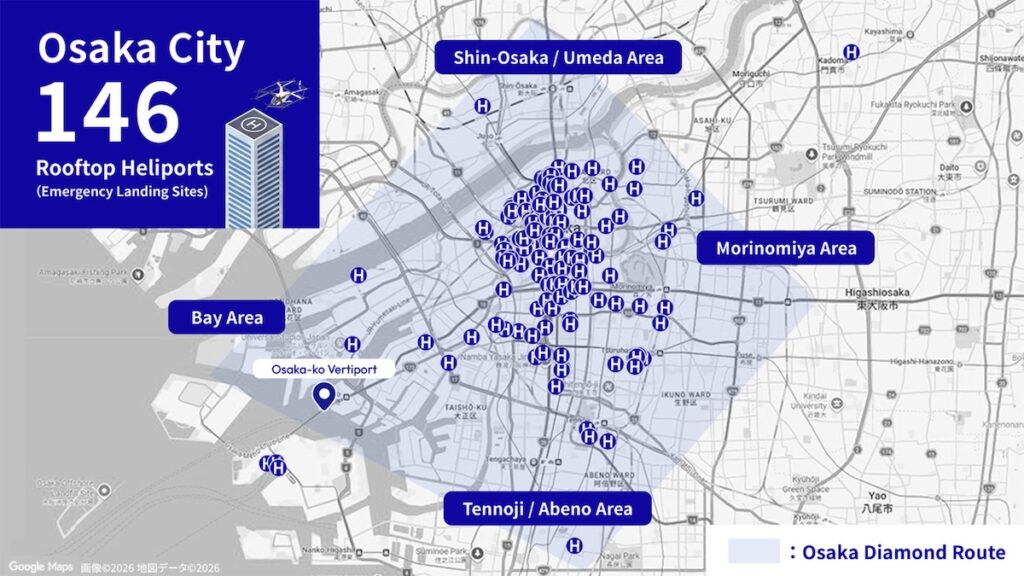
Establishing ground-up vertiport infrastructure presents severe economic and spatial challenges in central urban areas where open land is scarce and construction costs are high. Osaka City currently features 146 rooftop emergency landing sites, marked by an “H” symbol on buildings exceeding 100 meters in height to fulfill local fire safety regulations. Although these rooftops already possess reinforced floor loading, fire suppression systems, and lighting, current regulations restrict their use exclusively to emergency disaster relief.
The study will execute a phased technical evaluation across key operational domains to address regulatory and engineering barriers. Project partners will analyze high-rise airspace maps and obstacle limitation surfaces to ensure compliance with Civil Aeronautics Act standards. Localized aerodynamic surveys will assess building-induced wind behavior to set operational weather parameters, accompanied by noise simulations during takeoff, landing, and flight phases. Additional assessments will examine structural load capacities, passenger diversion movement flows, aircraft transport logistics in the event of mechanical failure, and electrical power grid upgrades required for charging infrastructure.
To ensure seamless integration, partners are consulting with the Osaka Municipal Fire Department to formulate emergency protocols and coexistence rules that balance lifesaving operations with daily transit. Because existing emergency helipads were built without commercial passenger standards in mind, the study combines desktop research with direct building assessments to gather necessary safety data. The resulting insights are intended to establish foundational vertiport standards and accelerate the adoption of urban air networks in other densely populated regions.