

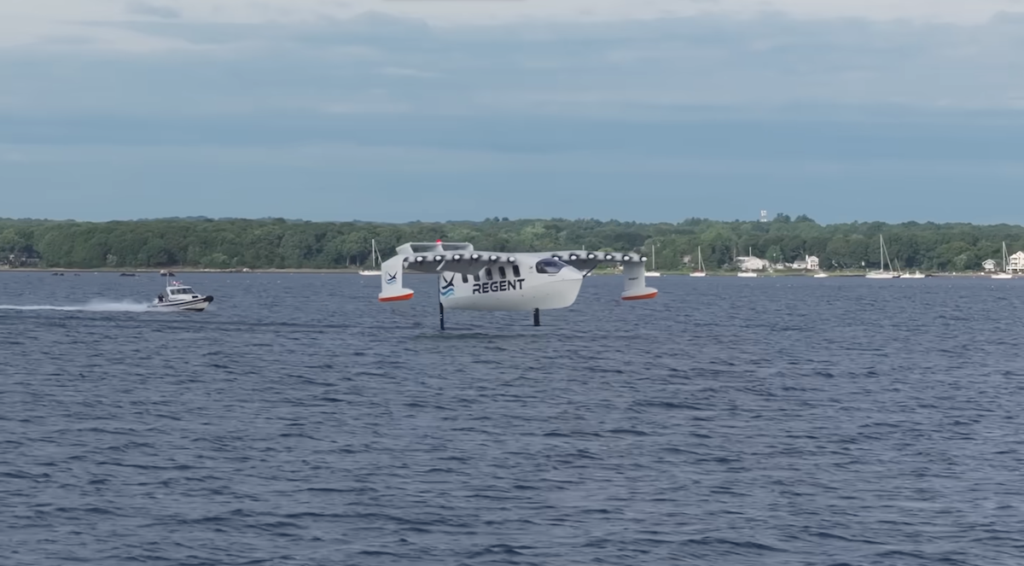
REGENT Craft’s Seaglider vessel prototype, Viceroy, has completed its first human-crewed flight over Narragansett Bay, marking the largest-ever all-electric wing-in-ground effect craft to fly with people on board.
Operating with a crew of two captains aboard, the prototype flew a distance of 1,956 feet at an altitude of 33 feet above the water for 30 seconds. The flight test provides critical validation of the technology and marks the start of the program’s final stage of sea trials. Throughout 2026, testing efforts across on-water operations and simulation-based development focused on increasing the vessel’s hydrofoiling speed to refine vehicle performance, de-risk operations, and accelerate readiness for commercial service and defense applications.
“This is the moment we have been envisioning and tirelessly pursuing for the past five and a half years: REGENT has successfully proven safe, efficient ground-effect flight,” said Billy Thalheimer, co-founder and CEO at REGENT. “The Viceroy Seaglider flight marks the start of a new era in mobility, unlocking opportunities across passenger travel, defense missions, and cargo transport. I’m so grateful to the amazing team who made history today. We’re now moving quickly toward production to deliver Seagliders to coastlines around the world.”
Seaglider vessels are high-speed, hydrofoiling wing-in-ground effect craft that combine the speed of an aircraft with the convenience of a boat. The vehicle operates in three distinct modes—float, foil, and fly—starting on its hull at low speed, transitioning to hydrofoils once clear of the dock, and taking flight within one wingspan of the water’s surface. Hydrofoiling gives the vessel wave tolerance and maneuverability near coastlines, while a triple-redundant digital control system autonomously manages stability, allowing the captain to steer the craft like a boat in flight.
Designed to seat 12 passengers and two crew, the production Viceroy vessel will fly at speeds up to 180 mph for distances up to 180 miles. Onboard, passengers can expect ample legroom, large windows, and a quiet ride while bypassing traditional airport check-in procedures. The vessels will be captained by certified mariners and regulated in the United States by the U.S. Coast Guard, alongside international maritime authorities.
“Completing this flight test validates years of rigorous engineering and operational work and gives us the confidence to move into full-rate production,” said Mike Klinker, co-founder and CTO at REGENT. “We showed today that flying a Seaglider is every bit as smooth and safe as we designed it to be. I can’t wait to get onboard and to share the experience with others as we make our vision for the future of maritime mobility a reality.”
To support scaling, REGENT completed construction of the world’s first Seaglider Manufacturing Facility in June, a 255,000-square-foot site at its Quonset, Rhode Island headquarters. Coming online this year as a global production hub, the facility will handle structural assembly, wing and hydrofoil integration, battery installation, and water-based testing. Built to scale in phases, the site anchors a domestic supply chain for end-to-end production of both the Viceroy passenger vessel and the autonomous Squire drone, which previously demonstrated defense-specific ground-effect flight.
REGENT currently holds a global order book spanning six continents. Luxury travel operator The Twenty Five serves as the initial domestic delivery partner with an order for up to 60 Viceroy Seagliders. In defense markets, REGENT maintains a $15 million contract with the U.S. Marine Corps Warfighting Lab and a CRADA with U.S. Special Operations Command to develop Seaglider platforms for contested logistics, medical evacuations, intelligence, surveillance, reconnaissance, and launched effects.