

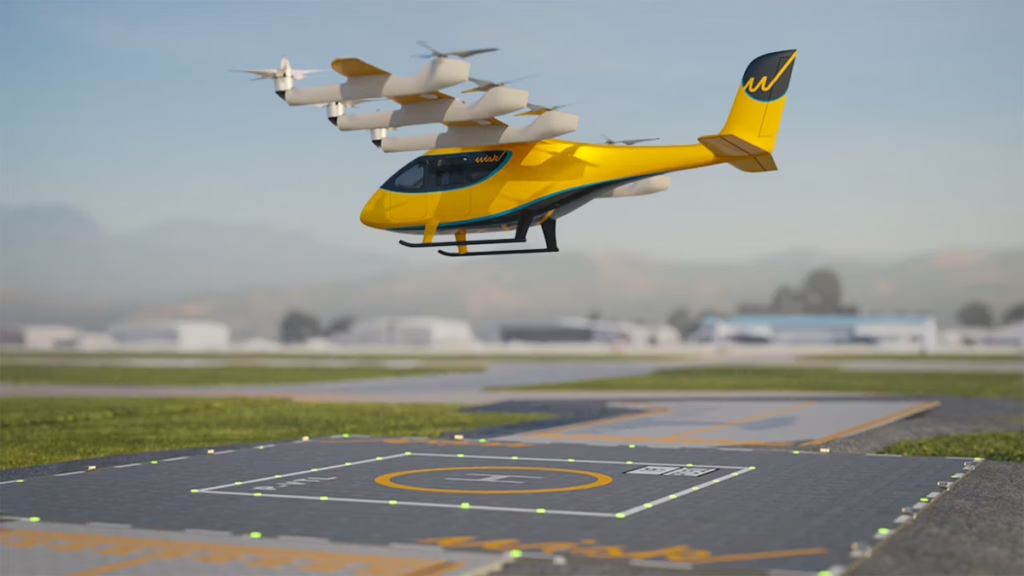
Wisk Aero has commenced construction on a new vertiport at Hollister Municipal Airport in California, establishing one of the first public airport vertiports in the United States designed to support both piloted and autonomous aircraft operations.
Situated adjacent to Wisk’s existing flight test facilities in Hollister, the 100-foot by 100-foot facility serves as a dedicated testbed to evaluate terminal area flight procedures, gather real-world operational data, and validate precision landing technologies. Information collected from test flights at the site will feed directly into regulatory and industry initiatives, including the Federal Aviation Administration’s (FAA) eVTOL Integration Pilot Program (eIPP) and the ongoing refinement of the FAA Vertical Lift Infrastructure Advisory Circular.
Built to existing FAA vertiport standards, the new infrastructure features a modular, deployable layout constructed with elevated steel structures, integrated solar panels, power banks, and taxiway connectors. Its relocatable template allows the platform to be deployed across various operational environments, including future eIPP flight testing planned in Texas.
“Breaking ground on this vertiport at Hollister Municipal Airport is a big moment for Wisk, AAM, and autonomous aviation,” said Annie Cheng, Senior Program Manager, Operational Integration and Testing, at Wisk. “By testing autonomous and piloted operations on an actual public airport, we are bridging the gap between advanced aircraft development and real-world infrastructure. The data and operational learnings generated here will directly feed into our autonomy stack and help shape the FAA’s foundational standards for future vertiport operations, moving autonomous air taxis significantly closer to commercial readiness.”
As a test and data-collection site, the vertiport enables Wisk to evaluate advanced landing technologies under nominal conditions, missed approaches, and GPS-denied environments. Transceivers developed by Wisk and installed directly on the pad will improve reduced and zero-visibility operations across all vertical takeoff and landing (VTOL) aircraft—including traditional helicopters, third-party eVTOLs, and Wisk’s 6th Generation air taxi. Initial surrogate flights and subsequent autonomy testing will generate data to continuously refine Wisk’s autonomy stack for future commercial service.
The project was made possible through close collaboration among key local, state, and federal stakeholders.