
A new academic and industry collaboration between Aeroberm and Bristol University aims to address acoustic challenges in the Advanced Air Mobility sector by evaluating how novel landing pad surfaces mitigate ground effect noise during take-off and landing.
As the Advanced Air Mobility industry races toward commercial launch, a collaboration between the University of Bristol, Swinburne University of Technology, and Aeroberm focuses on what many consider the single biggest threat to public acceptance of a vertiport ecosystem: noise. The University of Bristol’s Aeroacoustics Research Group has published a series of studies establishing that the solid ground surface beneath a rotor or propeller plays a significant role in noise generation. Research shows that when an aircraft operates close to the ground, a phenomenon called ground effect measurably amplifies acoustic output.
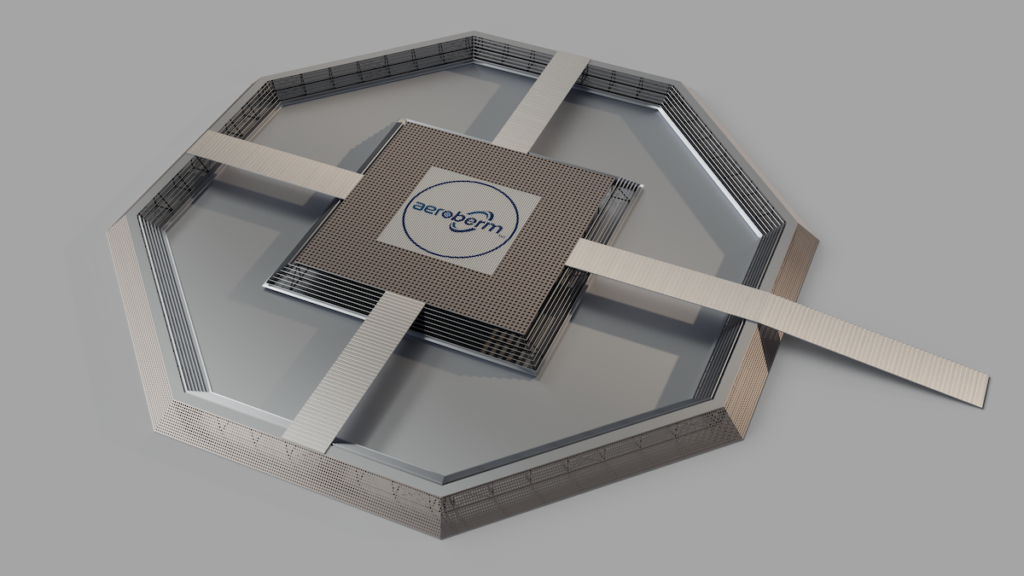
“From our studies to date on various generic surfaces we believe that replacing a solid ground surface with the elevated Aeroberm™ pad with a perforated fractal design will likely substantially reduce that noise penalty,” said Dr. Esmaeel Masoudi, lecturer in aeroacoustics at University of Bristol.
“While results will differ between aircraft configurations, based on the tests carried out in our wind tunnel facilities, we anticipate that the noise reduction could be up to 13 decibels for the first tonal component and up to 7 decibels in overall sound pressure level. At some observer angles, the elevated Aeroberm landing pad may effectively eliminate the additional noise associated with propeller–ground interaction, reducing the measured noise to the isolated propeller (baseline) level,” said Dr Masoudi.
Following this landmark research, the University of Bristol team will use its state-of-the-art wind-tunnel facilities to test Aeroberm’s patented fractal panel vertiport geometry. Because every aircraft possesses a distinct downwash, outwash, and noise signature shaped by its rotor count, disc loading, weight, and flight profile, researchers are extending an open invitation to electric vertical take-off and landing manufacturers. This allows aircraft developers to participate directly in testing to optimize panel geometry for their specific aircraft while shaping a standardized landing surface tailored to distinct acoustic and aerodynamic characteristics.
“It is a myth that electric air taxis will be silent. While they will blend into the background noise of a city when flying at altitude, there is no escaping the aero physics at a vertiport. A lot of air needs to be moved to achieve vertical flight and while the electric motor noise will be minimal, there will still be significant noise that could render some great vertiport sites unfeasible if not ameliorated,” said Clem Newton-Brown, CEO and founder of Aeroberm (a Skyportz company).
Noise concerns are anticipated to be among the most common reasons vertiport proposals stall at the planning stage. Unlike aircraft certification or battery technology, noise is experienced directly by the public. Developing infrastructure that meaningfully cuts noise does not just satisfy regulatory requirements, but builds the social licence required for advanced air mobility networks to operate in populated areas.