
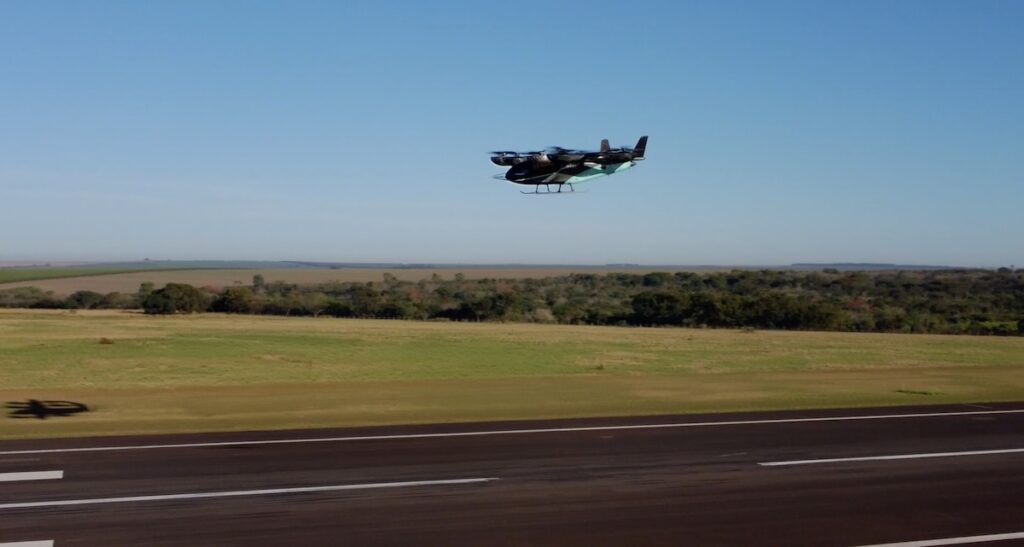
Eve Air Mobility’s engineering prototype has completed its first partial transition flight, marking an important milestone in the development and testing of the company’s electric vertical takeoff and landing aircraft.
The flight signified the start of the transition phase from vertical to wing-borne flight through the activation of the aircraft’s rear pusher propeller. Operating with the pusher activated up to 1,200 RPM, the aircraft attained a stabilized speed of 27 knots and a maximum ground speed of 30 knots. Over a total duration of 3 minutes and 9 seconds, the prototype covered approximately 0.84 nautical miles while reaching a maximum height of 90 feet above ground level.
“This first partial transition flight is an important milestone in Eve’s development journey,” said Johann Bordais, chief executive officer of Eve Air Mobility. “Successfully activating the pusher propulsion system in flight validates a key aspect of our aircraft design and brings us one step closer to delivering safe, efficient and scalable air mobility solutions.”
The transition phase is one of the most critical aspects of eVTOL flight, as it involves the aircraft moving from vertical lift to forward flight. The successful completion of this initial partial transition test further advances efforts to expand the aircraft’s flight envelope and validate system performance.
“This flight successfully demonstrated pusher activation in flight and validated key performance targets at the start of the transition phase,” said Marcelo Basile, head of engineering at Eve Air Mobility. “The data collected will support continued envelope expansion as we advance toward higher speeds and more complex transition flight testing.”
Eve’s flight test engineering team is continuing ongoing loads and structural analyses to support future envelope expansion. Over the coming weeks, the company expects to progressively expand the aircraft’s airspeed envelope with additional flights featuring pusher activation. Following the flight-testing program, plans are in place to conduct datalink testing to validate radio link performance and support operations at speeds up to 50 knots.