
Eve Air Mobility has welcomed the publication by Brazil’s National Civil Aviation Agency (ANAC) of the Proposed Noise Certification Criteria for Eve 100, the Company’s electric vertical take-off and landing (eVTOL) aircraft.
The publication marks a significant milestone toward establishing official operational standards for the next generation of urban air mobility.
The proposed criteria represent a key phase in the type certification process for the Eve 100 vehicle, acting as a critical foundation for environmental regulatory alignment. Because electric vertical take-off and landing (eVTOL) aircraft rely on innovative power configurations distinct from conventional aircraft, standard regulatory approaches are insufficient to address their unique operational and acoustic profiles. The newly introduced benchmarks were formulated through extensive technical collaboration between Eve Air Mobility and Brazil’s ANAC, adapting existing noise protocols to fit the specific operating dynamics of the vehicle.
“ANAC’s publication of the proposed noise certification criteria is an important milestone in the development and certification of Eve 100,” said Johann Bordais, CEO at Eve. “We appreciate ANAC’s leadership and collaborative approach in developing a framework tailored to this emerging technology aircraft. This initiative supports the safe and responsible introduction of eVTOL operations for urban mobility while promoting international regulatory alignment.”
Acoustic management stands as a central pillar of the public validation process required for commercial urban aviation. The proposed evaluation methods are structured to closely monitor the sound characteristics of the Eve 100 across all flight phases, generating a comprehensive assessment of the environmental footprints generated prior to standard deployment.
”Aircraft noise is a critical component of aviation environmental certification and an important factor in public acceptance of urban air mobility,” said Isabel Lima, Head of Noise and Vibration at Eve. “Noise certification establishes measurement methodologies and compliance criteria, ensuring that new aircraft are introduced with appropriate environmental protection and consideration for surrounding communities.”
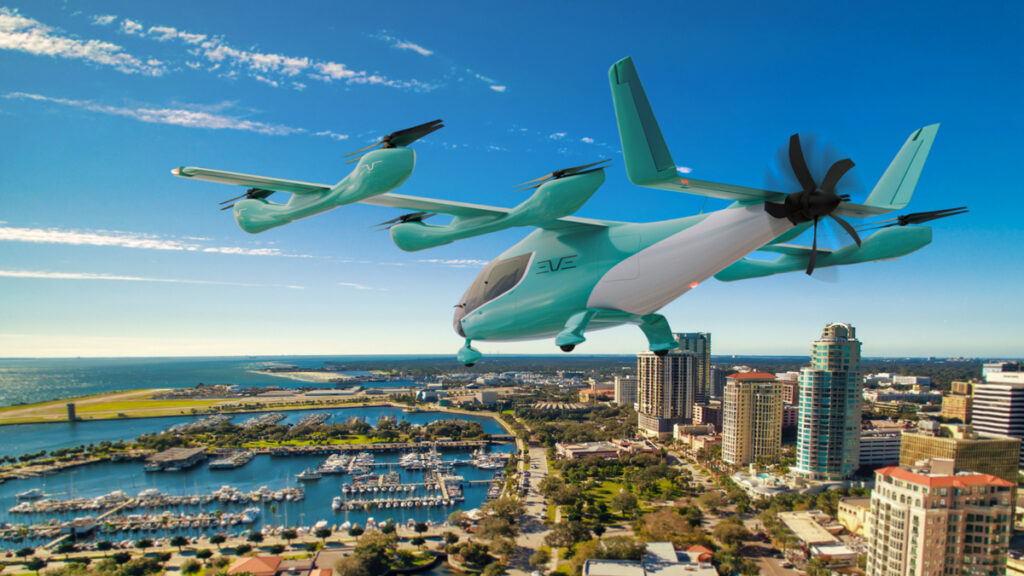
Engineering teams have factored low-noise targets directly into the physical infrastructure of the Eve 100 from its earliest design phases. Utilizing a distinct lift-plus-cruise engineering architecture, the propulsion layout is optimized to generate a significantly quieter signature than standard conventional helicopters.
To complement ongoing acoustic assessments and mathematical modeling, Eve has worked alongside the Royal Netherlands Aerospace Centre to conduct a Visual & Sound Perception Study. The study utilized virtual reality and acoustic simulations to capture responses from more than 100 participants across New York, Orlando, and San Francisco, gathering data on how suburban and urban populations perceive the physical and audio presence of active eVTOL systems. Concurrently, physical testing of engineering flight prototypes continues to generate live data to further optimize acoustic dampening as the vehicle moves closer to final production stages.
Once the public comment window concludes on August 08, ANAC will review the submitted stakeholder feedback to refine and finalize the formal environmental certification guidelines. While working alongside ANAC as its primary regulating body, Eve is actively seeking international validation channels to ensure the infrastructure aligns with requirements for future global deployment.