
Vigilant Aerospace has conducted a new round of flight tests and real-world demonstrations of its FlightHorizon PILOT onboard detect-and-avoid (DAA) system, validating critical automated tactical safety capabilities required to scale advanced air mobility (AAM) operations.
The dual-use system, originally developed for the US Air Force under an SBIR contract and built around two licensed NASA patents, was evaluated across two unique configurations to address the mixed aircraft traffic realities of integrated airspace. The flights tested a lightweight civilian model featuring a transponder receiver and direct autopilot integration, alongside a heavier version equipped with an integrated compact onboard radar dedicated to tracking non-transponder-equipped aircraft. Operating on a single-board computer, the lightweight iteration consolidates detection, tracking, target correlation, and standards-compliant avoidance calculations into a low size, weight, power, and cost (SWaP-C) package suitable for small uncrewed aircraft systems (UAS).
The technology integration and test flights were executed through a $1 million development project in partnership with Oklahoma State University’s Oklahoma Aerospace Institute for Research and Education (OAIRE) and received foundational support from the Oklahoma Center of the Advancement of Science and Technology.
Kraettli L. Epperson, CEO of Vigilant Aerospace, said, “The future of aviation will largely be autonomous, which will require automatic onboard safety systems. The new rules and standards are emerging today that will set the requirements for integration of drones into the national airspace, so capabilities like those we are developing in FlightHorizon PILOT are designed to get ahead of the requirements and allow industry to being planning and preparing today. These most recent flight test milestones help to provide a path to enabling the industry to execute safe beyond visual line-of-sight flight for both small and large UAS, with fully onboard safety systems.”
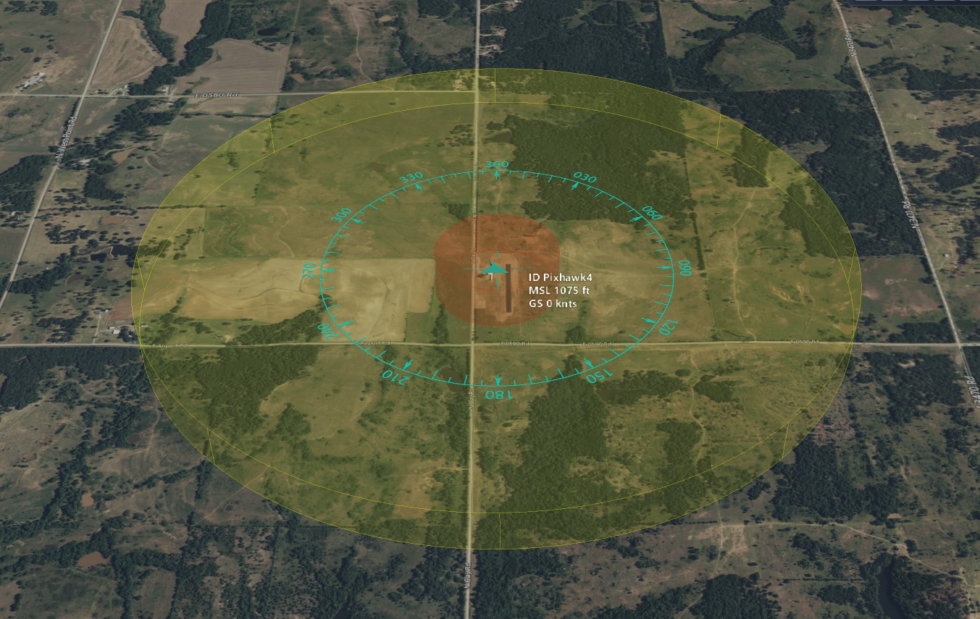
By processing dynamic airspace data, the single-board computer tracks surrounding aircraft relative to the UAS, projects trajectories, and yields real-time alerts. Avoidance commands are calculated using FAA-provided ACAS-X algorithms, allowing the system to feed reactive flight commands directly to the onboard autopilot while simultaneously broadcasting situational telemetry to a ground-based viewer software outfitted with a moving map for pilot supervision.
The recent operational phase evaluated an NDAA-compliant Group I hexacopter drone through radar and non-radar flight profiles, prioritizing software tuning, radar filtering, and performance cross-validation across multiple aviation-certified and uncertified single-board computing units. Operators can deploy the system without a radar component to establish a cooperative airspace profile where all regional traffic utilizes transponders, or activate the radar variant in non-cooperative airspace to detect non-broadcasting aircraft. Architected to support compliance with technical baselines such as RTCA DO-365C and ASTM F3442-25, the software system continuously logs comprehensive air traffic and avoidance-command parameters to establish transparent safety baselines for complex commercial or multi-rotor configurations.
Operational evaluations with OSU are scheduled to transition to a significantly larger Group II civilian fixed-wing drone. Powered by a gasoline engine, this platform is engineered to transport a 60-pound payload over distances reaching 300 miles, making it highly applicable to long-range AAM utility operations including firefighting, search and rescue, long-distance supply delivery, and infrastructure inspection. Demonstrating both configurations of FlightHorizon PILOT establishes an incremental safety pathway spanning small commercial assets up to larger, automated platforms that require deep sensor integration to operate reliably alongside traditional aviation infrastructure.