
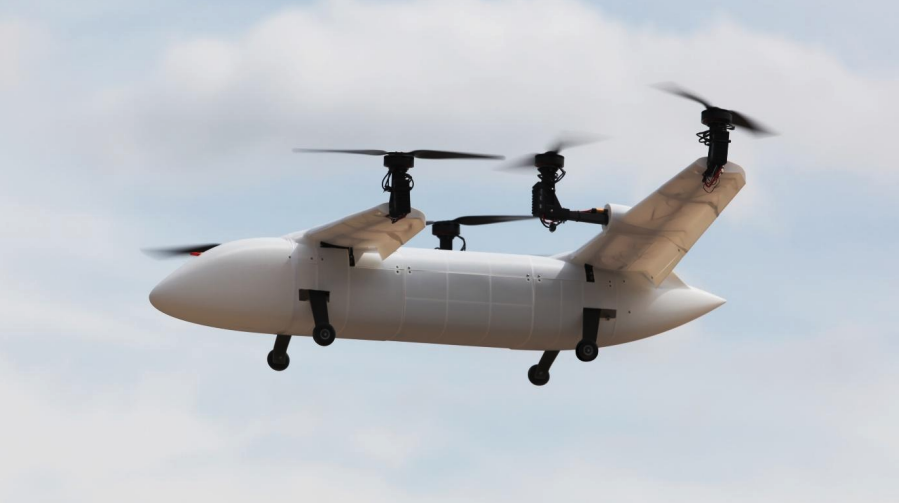
Sora Aviation has successfully completed an extensive programme of vertical take-off and landing flight testing with its subscale S-1 demonstrator.
The UK-based developer of the 30-seat S-1 electric Vertical Take-Off and Landing (eVTOL) aircraft utilized the scaled model to validate aerodynamic behaviour, flight control laws, and handling characteristics. The test vehicle has been flying regularly for several months, with dozens of successful flights completed to date. Flight testing has now become a routine weekly activity for the engineering team, providing a continuous stream of data to support the development of the full-scale S-1 aircraft.
To generate representative aerodynamic and flight dynamics data, the demonstrator’s outer mould line faithfully replicates the geometry of the full-scale S-1, including its control surfaces, proprotor positioning, and centre of gravity location. This design ensures that the aircraft exhibits flight characteristics directly relevant to the full-scale model.
The campaign provided a robust validation of Sora’s proprietary flight control system architecture. Developed in-house, the system is supported by comprehensive Software-in-the-Loop and Hardware-in-the-Loop development workflows to enable verification prior to flight and reduce test risk. Data gathered during the campaign demonstrated the effectiveness of the flight control system and validated low-speed handling qualities alongside aircraft performance predictions.
This flight test programme forms part of a wider verification and validation strategy that includes extensive ground testing, high-fidelity simulation, and wind tunnel testing.
Dr. Luke Bowen, Senior Aerodynamics Engineer at Sora Aviation, said, “Flight testing is one of several complementary tools we use to build confidence in the aircraft design. The data we’ve collected has shown excellent correlation with our flight dynamics models and simulation results. While subscale testing inevitably comes with limitations, particularly in perfectly matching full-scale Reynolds number effects, we have developed a targeted test methodology focused on the areas where representative data can be obtained most effectively. This allows us to directly validate our analysis methods and improve the accuracy of our predictive tools as we progress toward fullscale flight.”
Multiple additional ground and flight demonstrators are currently under construction to support the maturation of key technologies and systems across the aircraft programme. Sora Aviation is targeting the first flight of its full-scale S-1 prototype in 2028, aiming to deliver a new generation of high-capacity, economically viable electric air transport.
Furqan Afzal, CEO of Sora Aviation, said, “This milestone demonstrates the maturity of our development approach and the strength of the engineering foundations underpinning the S-1 programme. We’ve deliberately invested in a rigorous test-and-validation strategy that combines simulation, laboratory testing, wind tunnel campaigns and representative flight demonstrators. The results we’re seeing continue to reinforce our confidence that the S-1 can deliver the performance, safety and economics required to transform advanced air mobility at scale.”