

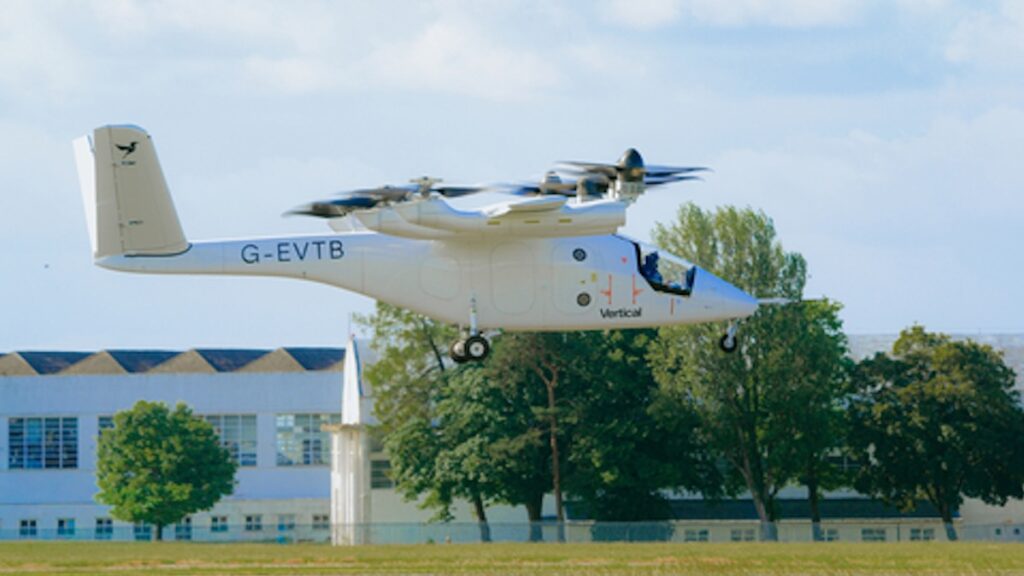
Vertical Aerospace has completed the maiden piloted flight of its latest full-scale prototype aircraft, marking the beginning of an expanded flight test campaign.
The flight was conducted by Vertical Test Pilot Paul Stone at 8:49 BST on June 5, 2026, at the company’s Flight Test Centre in the UK. The milestone follows the issuance of a new Permit to Fly from the UK Civil Aviation Authority after extensive ground testing and aircraft validation activities.
The new prototype is the final aircraft to join Vertical’s flight test fleet before the company completes its Critical Design Review, a programme milestone that will establish the design baseline for certification. Following the review, Vertical plans to begin preparations for assembly of its first pre-production aircraft.
According to the company, the addition of the aircraft doubles its flight testing capacity and will support additional public demonstrations this year. The prototype is expected to progress through all phases of piloted flight testing, including thrustborne, wingborne, and transition flight.
Vertical also stated that its existing prototype continues transition flight testing and has already completed multiple piloted transition flights.
Stuart Simpson, CEO of Vertical Aerospace, said, “Getting our latest prototype into flight testing is an important milestone because it allows us to learn faster in real world conditions and keep building momentum towards certification. Expanding the flight test fleet will help us validate the aircraft more quickly, reduce risk, and move more efficiently towards bringing Valo into service.”
The aircraft shares the same configuration as Vertical’s current full-scale aircraft, which has already completed all flight test phases. The company said its flight test programme is based around full-scale piloted prototype aircraft with architecture, systems, and flight characteristics closely aligned to the production-standard Valo aircraft.
Vertical said that, following completion of all phases of piloted flight testing in its all-electric configuration, it intends to retrofit the prototype for hybrid-electric flight testing. The hybrid-electric variant is expected to support applications requiring greater range and payload capability across defense, logistics, and commercial sectors.