

An engineering and data partnership between AirIndex and Aeroberm has launched to address significant infrastructure deficiencies that prevent existing American heliports from safely supporting the advanced air mobility rollout.
An independent analysis of the Federal Aviation Administration (FAA) Airport Master Record conducted by AirIndex revealed systemic failures in the national landing infrastructure record, noting that 98.5 percent of the 5,647 registered U.S. heliports have never undergone independent field inspections. Furthermore, more than 1,121 active hospital helipads lack FAA registration within a nautical mile, and multiple facility records suffer from inaccurate coordinates or outdated elevation data. While human pilots manually mitigate these discrepancies using visual judgment, automated and semi-automated electric vertical takeoff and landing (eVTOL) aircraft rely on absolute data accuracy for safe operations.
“The federal landing record was built for a world where pilots looked out the window and made judgment calls. Automated eVTOL flight assumes the record is right: the location, the dimensions, the obstructions. Our analysis shows it frequently isn’t. This partnership means we move from measuring the gap to closing it,” said Alan Holmes, Founder & CEO, Vertical Data Group / AirIndex.
Dimensional limitations pose an additional hurdle for the aviation transition. The median pad size among the 5,594 registered U.S. heliports with recorded data is only 48 feet. Under current FAA Engineering Brief 105A design guidance, compliant final approach and takeoff areas for eVTOL operations require load-bearing zones that are roughly double the aircraft reference dimension, establishing typical minimum thresholds at 100 feet or more. Consequently, over half of all registered domestic heliports are dimensionally non-compliant for air taxi deployment based on recorded data alone.
Aerodynamic forces introduce further engineering complexities, as multi-rotor eVTOL configurations generate significant downwash and outwash velocities. Full-scale outwash measurements conducted by the FAA in December 2024 confirmed that velocities at pad perimeters regularly exceed the 34.5 mph hazard threshold defined in Engineering Brief 105A, introducing safety risks for ground crews, passengers, and bystanders.
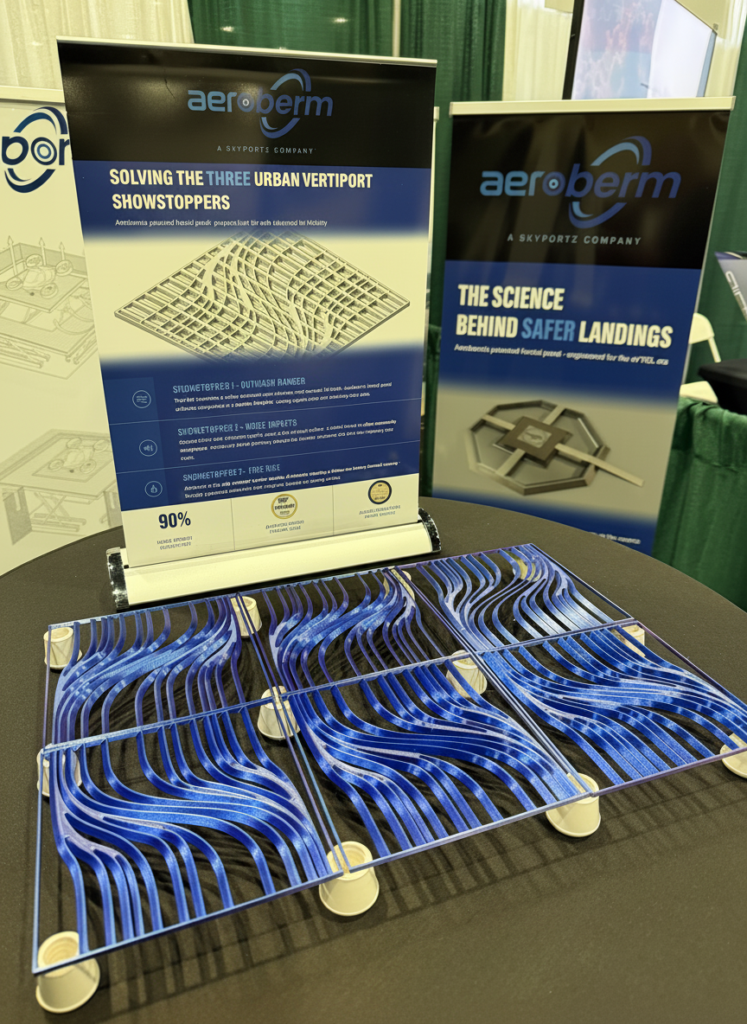
To bridge these technical gaps, Aeroberm, a Skyportz Australia company, developed a patented modular vertipad system engineered to mitigate rotor downwash, ground-effect noise amplification, and lithium-ion battery thermal runaway hazards. Validated by Large Eddy Simulation computational fluid dynamics research at Swinburne University of Technology, Australia, the fractal panel system dissipates rotor wake energy approximately 90 percent faster than conventional flat tarmac. The modular design enables direct retrofitting on existing concrete surfaces, bypassing the need for bespoke construction to rapidly upgrade physically adequate but aerodynamically unsuitable pads.
“The AirIndex research makes something explicit that the industry has been dancing around,” said Clem Newton-Brown, Founder and CEO of Skyportz Australia and creator of the Aeroberm™ patent. “The existing helipad record is not a reliable foundation for eVTOL planning. And even where pads are real, inspected, and correctly recorded, most of them are the wrong size and none of them are engineered for the aerodynamic reality of multi-rotor eVTOL. Aeroberm was designed specifically for this gap. The partnership with AirIndex means we can now identify which existing facilities are candidates for retrofit, what engineering intervention each one needs, and deliver a modular solution that meets the emerging regulatory standard at an affordable cost.”
The strategic collaboration will combine the multi-source audited database from AirIndex with the modular engineering systems of Aeroberm to provide systematic retrofit assessments for helipad operators, hospital networks, and airport authorities. The rollout will initially target the United States before expanding internationally.
Highlighting the global scale of the issue, industry expert Rex Alexander, President of Five Alpha LCC, provided context on the historical regulatory environment surrounding private-use infrastructure, “The vertical flight data integrity issue is not unique to the United States; similar challenges have been observed in numerous countries around the world. It is also not an FAA-generated problem. The FAA has not been granted comprehensive federal oversight authority over most private-use aviation facilities comparable to its authority over certificated public-use airports. As a result, there has historically been limited funding, staffing, and regulatory incentive to systematically verify and maintain accurate infrastructure data for thousands of private-use vertical flight facilities.
“A significant regulatory gap exists because many private-use facilities that support commercial aviation activities, including hospital heliports and other facilities supporting commercial air operations, are not subject to comprehensive federal infrastructure standards or routine inspection programs. Consequently, the FAA generally lacks direct authority to compel private-use facility owners to comply with FAA heliport design guidance and infrastructure standards unless specific regulatory or operational circumstances apply.
“Until such time as Congress provides additional statutory authority and funding to address these issues, the FAA’s ability to systematically improve the accuracy, completeness, and verification of vertical flight infrastructure data will remain limited.”