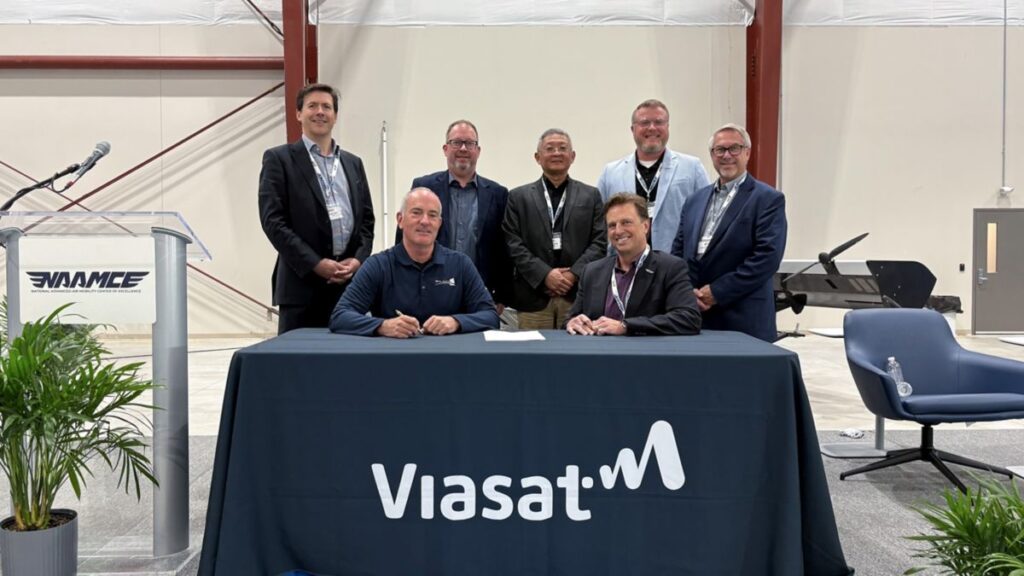
Viasat has expanded its Velaris ecosystem by partnering with L2 Aviation and Galaxy 1 Communications to bridge the gap between technical feasibility and certified deployment for Advanced Air Mobility platforms.
While much of the sector has previously focused on demonstrating technical feasibility, the safe scaling of operations depends on embedding connectivity into certified avionics architectures capable of operating within regulated airspace. By bringing L2 Aviation into the ecosystem, the partners aim to provide the engineering and certification expertise necessary to move uncrewed aircraft systems from prototypes to active deployment.
L2 Aviation brings nearly three decades of experience as a specialist in avionics design, engineering, manufacturing, and installation. The company has an established track record of delivering safety-critical aircraft modifications for commercial, business, cargo, and military fleets. Within this new framework, L2 will focus on the integration and certification of satellite communications for uncrewed systems.
The connectivity is powered by Viasat Velaris, which provides global satellite links designed specifically for uncrewed aircraft to support command and control and other essential operational data. This service is distributed via Galaxy 1 Communications through a Managed Distribution Partner-as-a-Service model. This approach abstracts the complexities of provisioning, billing, and compliance oversight into a unified operational framework.
“Right now the industry is focused on what it will take to enable routine, regulated AAM operations: so it is clear that certification ready connectivity and avionics integration must advance together.” said Joel Klooster, SVP Aircraft Operations and Safety at Viasat. “Bringing L2 Aviation into the Velaris ecosystem through G1 reflects that shift from proving concepts to building operational capability. Their experience strengthens how Velaris supports the next phase of AAM deployment, where safety, certification, and scalability are immediate priorities.”
The collaborative effort focuses on ensuring that these new aerial platforms meet real-world airworthiness standards. This is essential for gaining the trust of regulators and providing operators with reliable daily systems.
“Advanced Air Mobility will not scale on capability alone. It will scale when that capability is engineered into certified, operational systems that regulators trust and operators can rely on every day,” said Tony Bailey, President and Chief Operating Officer at L2 Aviation. “Our role within the Velaris ecosystem is to integrate satellite connectivity into avionics architectures that meet real-world certification standards. Working alongside Viasat Inc. and Galaxy 1 Communications, we are focused on delivering systems that are certifiable, scalable, and ready to support routine AAM and uncrewed operations.”
By combining resilient multi-network communications with established operational frameworks, the partnership aims to accelerate the commercial viability of regulated flight.
“Advancing safe, scalable UAV and AAM operations requires more than just connectivity — it demands a fully integrated, certifiable ecosystem,” said Gino Jensen, Chief Technology Officer at Galaxy 1 Communications. “Our programme is focused on delivering exactly that, combining resilient multi-network communications with the operational frameworks needed for regulated flight. Bringing on board L2 Aviation as a partner is a significant step forward. Their deep expertise in avionics integration and certification strengthens our ability to support airworthiness, compliance, and system interoperability—helping accelerate the path from innovation to real-world, commercially viable deployment.”