
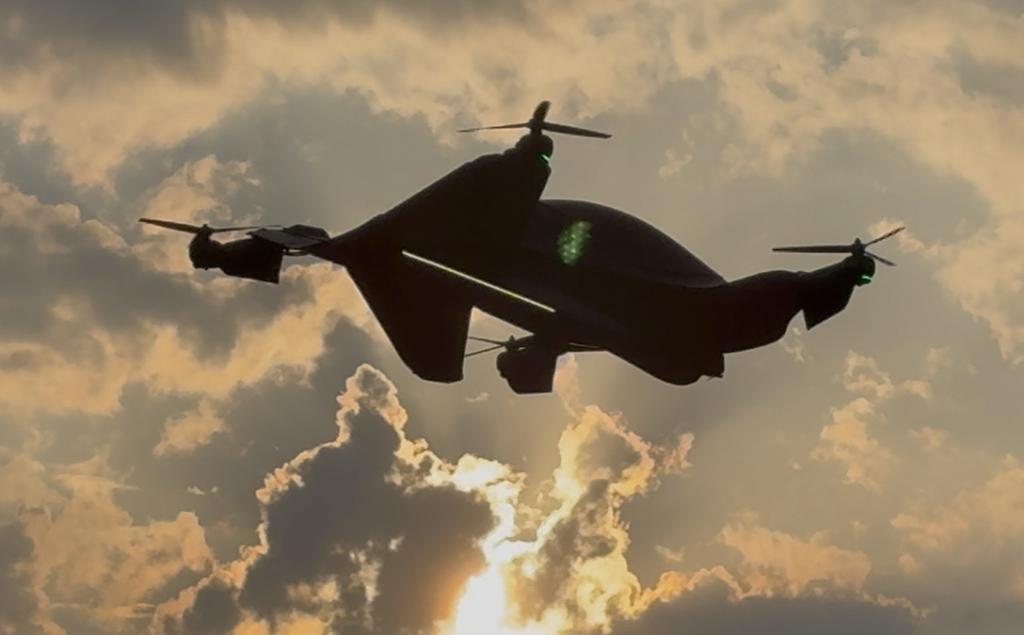
AltoVolo has officially moved into the production phase for a full-scale demonstrator of its Sigma aircraft following the successful flight testing of a quarter-scale prototype.
The company has characterized the Sigma as the world’s first HyperTOL (Hybrid Performance Take-off and Landing) aircraft. This designation follows a rigorous testing program, with the preliminary design review now complete, the engineering team has finalized the specifications for the first production model, shifting focus toward detailed engineering and formal certification requirements.
A significant technical pivot in the aircraft’s development is the transition from electric ducted fans to an open rotor configuration. After an extensive research and development program, the company determined that closed rotors introduced unnecessary weight, inertia, and complexity. The move to open rotors has doubled the Sigma’s hover time, reduced propeller loading, and improved tilt transition characteristics. To support this change, the team developed a proprietary fixed-pitch racing propeller concept designed to outperform standard commercial options.
The Sigma is engineered with a hybrid-electric tilting propulsion system, allowing for a 500-mile range and a top speed of 220mph. Designed for urban and regional versatility, the two-seat aircraft is 4.9 meters wide and weighs 980kg, including capacity for two passengers and luggage. Safety features include a ballistic parachute and a redundant motor system that allows for stable flight even after the failure of one motor set. Its noise profile is reportedly 80% quieter than a traditional helicopter, facilitating operations in residential areas.
To navigate the regulatory landscape, AltoVolo has recruited a dedicated Head of Certification and a team of experts with experience in certifying complex aircraft. The company is pursuing full type certification to allow for the broadest possible commercial use cases. While the aircraft is designed for professional utility, it is also accessible to Sport Pilot certificate holders. These pilots can operate the Sigma with 25 hours of training, though they remain restricted to daylight and fair-weather operations.
The founding team has been successful in attracting top-tier talent from the aerospace industry, fortifying the company with experts who have built and certified complex aircraft before and are well versed in the challenges that lie ahead.
The first full-scale demonstrator is scheduled for completion by the end of 2026. This aircraft will serve as the foundation for the manufacturing readiness review, which is the final step before the commencement of serial production.