
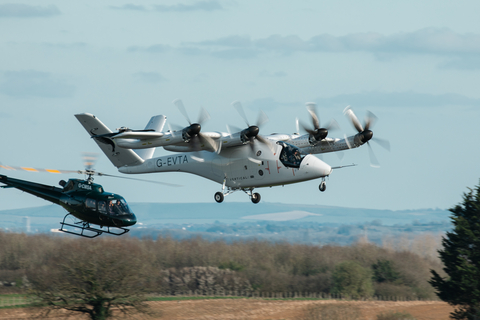
Vertical Aerospace has achieved a significant technical milestone with the successful piloted thrustborne transition of its full-scale electric Vertical Takeoff and Landing (eVTOL) aircraft.
The flight took place on 2 April 2026 at the company’s Flight Test Centre at Cotswold Airport, with Test Pilot Paul Stone at the controls. During the maneuver, the aircraft performed a vertical takeoff before tilting its front propellers forward to accelerate into wingborne flight. As the aircraft gained speed, the rear propellers stowed to allow for an energy-efficient cruise, concluding the mission with a conventional runway landing.
This flight represents the completion of the first half of a “two-way transition” sequence. This capability is essential for point-to-point urban air mobility, as it allows an aircraft to operate from helipads and rooftops without a runway while maintaining the efficiency of a fixed-wing plane during transit. The achievement follows nearly two years of piloted testing, which included the first winged eVTOL flight in open European airspace.
The testing was conducted under the oversight of the UK Civil Aviation Authority (CAA), which is collaborating with the European Union Aviation Safety Agency (EASA). This regulatory involvement is a critical component of the certification path for Valo, Vertical’s intended commercial aircraft. The company is currently expanding the flight envelope from both ends, focusing on accelerating from a hover and decelerating from wingborne flight back to a vertical landing.
This technical progress coincides with a recently announced agreement in principle for a financing package of up to $850 million. This capital is intended to support the company through the type certification process and into commercial operations.
Stuart Simpson, Chief Executive Officer at Vertical Aerospace, said, “This marks a turning point not just for Vertical Aerospace, but for the entire advanced air mobility industry. Achieving piloted thrustborne transition under active regulatory oversight — alongside the recently announced financing package — demonstrates that we have solved the hardest engineering challenges, have the regulatory relationships to complete certification, and now have the financial foundation to see this through to commercial service.”
The flight provided real-world validation of the company’s distributed electric propulsion and tiltrotor technology. Each phase of the flight test program is backed by structural testing and simulator work to ensure the aircraft performs according to its design specifications.
David King, Chief Engineer at Vertical Aerospace, said, “Completing this piloted transition milestone is a profound achievement and the result of years of engineering innovation and disciplined test execution. The aircraft performed exactly as designed, transitioning smoothly and under full control — proving the core elements of Vertical’s distributed electric propulsion and tiltrotor technology at full scale, in real flight conditions. This is not yet final mission accomplished, but it is a pivotal technical proof point on our path to two-way transition.”
Test Pilot Paul Stone added, “This aircraft was made to transition. From the moment the front propellers tilted and the aircraft began to accelerate, the response was exactly as the simulation predicted — smooth, stable, and fully under control throughout. What the engineering team has built here is genuinely extraordinary. The aircraft handled the transition with a level of confidence that gives me great optimism for everything that comes next.”
Vertical Aerospace has now moved into the final stages of its four-phase flight test program. Having completed tethered, thrustborne, and wingborne phases, the company is now focused on the final requirements for full two-way transition.