India is positioned to evolve into one of the world’s largest passenger air taxi markets over the next two decades according to new analysis from modular vertipad developer Skyportz.
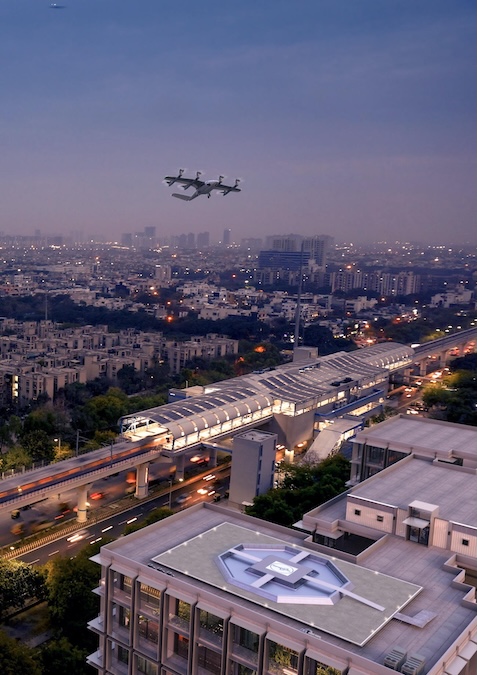
The Advanced Air Mobility (AAM) Vertiport Market Study identifies Delhi as a high-potential launch city with the capacity to support around 40 million passenger trips per year by 2045. This regional demand is expected to generate approximately US2.5 billion. To support this volume of traffic, the study forecasts a requirement for 10,000 to 15,000 vertipads across India, anchored by a network of roughly 2,200 pads in Delhi.
Several critical factors drive this growth in the capital region, including long average commute distances and low peak-hour travel speeds that heighten the value of time saved by aerial transit. The high reliance on road-based transport and the growing wealth of residents further support the displacement of traditional commuter volumes. Additionally, the market benefits from relatively low operating costs and capital requirements compared to other major global cities.
To address the need for rapid infrastructure scaling, the Aeroberm modular vertipad system has been designed for high-density urban environments. The system allows for the rapid installation of ground-level and rooftop pads while managing downwash safety, noise, and operational performance. This modular approach is intended to facilitate incremental expansion as aircraft fleets grow from dozens to thousands of units.
Clem Newton-Brown, CEO of Skyportz, commented, “Delhi’s numbers make one thing clear: this is not a small boutique market. Our modelling points to thousands of vertipads, tens of millions of passengers and sustained long-term infrastructure demand. That scale requires modular, affordable systems designed for networks such as the Aeroberm.”
Newton-Brown is currently engaging with the Directorate General of Civil Aviation (DGCA) and local air taxi developers, including ePlane, Sarla, Nalwa, and BluJ Aero, to discuss the deployment of city-scale AAM infrastructure. “With Delhi as a lead market, India has an opportunity to help shape how city-scale AAM infrastructure is deployed. We look forward to working with the DCGA and local air taxi developers,” Newton-Brown said.
The development of these modular systems is being guided by global regulatory standards to ensure safety and scalability. Robert Bassey, a strategic adviser to Skyportz and former FAA national lead for vertiport design, emphasized the importance of meeting regulatory expectations for performance evidence and defined operating assumptions.
“Having worked inside the FAA, I understand what regulators need to see before new infrastructure can scale – clear performance evidence, defined operating assumptions and a credible inspection and lifecycle framework,” Bassey said. “Our focus at Skyportz is on building a modular vertipad product that can be evaluated consistently across markets and accepted by regulators worldwide. India is a critical advanced air mobility market, and I look forward to constructive engagement with DGCA and industry as safe, scalable frameworks continue to take shape.”