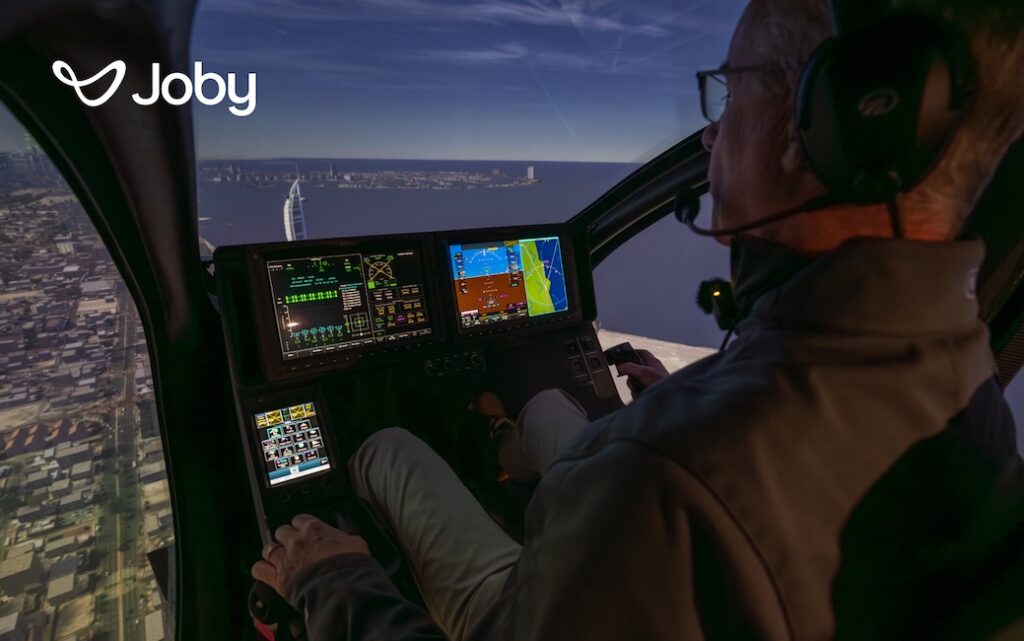
Joby Aviation has accepted the first of two high-fidelity flight simulators developed in partnership with CAE to facilitate pilot training for its upcoming electric air taxi service.
The installation marks a significant milestone in the development of the infrastructure required for commercial single-pilot electric vertical takeoff and landing (eVTOL) operations. The first unit, a 3000 series fixed-base training device, is being installed this month at Joby’s manufacturing and pilot training center in Marina, California. A second, full-motion simulator is expected to arrive later this year. Together, these devices are designed to support the training of up to 250 pilots annually.
Bonny Simi, President of Operations for Joby, commented, “These simulators are central to the FAA certification process and are being delivered on time to support pilot training ahead of Joby’s first commercial flights planned for this year.
“Developing flight simulators that are fully qualified by the FAA takes years of work and access to aircraft data, and it is required for Part 135 operations of eVTOL aircraft in the United States. Having started this multi-year process with CAE in 2022, Joby is progressing in developing qualified, scalable pilot training infrastructure as we near commercial operations.”
The technology utilizes CAE’s Prodigy Image Generator, which incorporates Unreal Engine gaming technology and artificial intelligence to create 3D urban environments. Pilots are provided with a 300-by-130-degree field of view, complemented by audio cues, vibration systems, and simulated turbulence that mirrors real-world flight conditions, including wind flow around ground structures.
Alexandre Prévost, President of Civil Aviation at CAE, stated, “CAE is proud to partner with Joby to bring world-class simulation technology to the emerging eVTOL market. These simulators set a new benchmark for training infrastructure in urban air mobility. By leveraging decades of expertise in high-fidelity simulation, we are helping Joby prepare pilots for safe, efficient operations and supporting the industry’s transition to sustainable air transportation.”
The first simulator is targeted for FAA Level 7 Flight Training Device qualification, while the second unit is intended to meet Level C Full Flight Simulator standards, providing motion across all axes. The development process has involved rigorous testing of flight physics and human factors across several facilities in California and a software development center in Costa Rica.
These high-fidelity simulators are designed to be a digital twin of our aircraft, providing us a means of compliance and a robust tool to help prepare our pilots for the unique demands of high-volume operations in urban environments.