

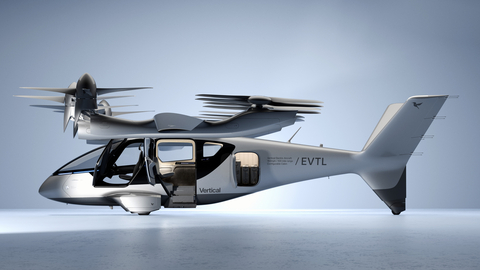
Vertical Aerospace has unveiled Valo, its new commercial electric vertical takeoff and landing (eVTOL) aircraft, which will enter service following regulatory approval.
Valo succeeds the company’s VX4 prototype and features a more advanced design based on insights from the piloted test program and feedback from airline and operator customers. Developed in collaboration with partners including Honeywell, Syensqo, and Aciturri, Valo introduces a more aerodynamic airframe, an under-floor battery system, a redesigned wing and propeller architecture, upgraded materials, and full certifiable redundancy. This design is engineered to meet rigorous safety standards, targeting airliner-level safety certification (UK/EU 10⁻⁹; CAA/EASA, SC-VTOL Category Enhanced) for global portability.
The aircraft is designed to fly up to 100 miles at speeds up to 150 mph with zero operating emissions and quiet performance (<50 dBA in cruise). Valo is targeting Type Certification in 2028 ahead of entering service with airline and operator customers, with early commercial routes expected to include airport-to-city-centre connections.
Valo’s premium cabin will initially launch with four seats, offering panoramic windows, personal space, and a cockpit divider. Its flexible design allows for expansion to six seats, which could improve operator economics and potentially lower passenger fares. In response to airline feedback, Valo features the largest cargo hold in its class, with room for six cabin bags and six checked bags. The aircraft’s platform is designed to support emergency medical services, cargo missions, and future defence, hybrid, and autonomous variants. The total payload at entry into service is targeted at 550 kg (1,200 lbs).
The design incorporates eight electric motors (EPUs), each powered by multiple electrically isolated power lanes to ensure maximum safety. Battery power is provided by eight liquid-cooled under-floor battery packs, with a target of approximately 12-minute recharge time for short missions.
Vertical is nearing the completion of full piloted transition flight with its full-scale prototype, a manoeuvre where the aircraft shifts from vertical lift to forward flight. Previous test phases validated hover, thrustborne, and wingborne performance, generating data that shaped Valo’s certifiable design. The company will now build seven certification aircraft in the UK to support final testing with the UK Civil Aviation Authority (CAA) and the European Union Aviation Safety Agency (EASA).
Stuart Simpson, CEO of Vertical Aerospace, stated: “With the launch of Valo, Vertical moves from prototype developer to aerospace manufacturer. Valo is the aircraft that turns electric flight into a commercial reality — clean, quiet, fast and engineered for everyday service. It marks a new dawn in transport, one that will connect people in minutes, not hours.”
Domhnal Slattery, Chair of Vertical Aerospace, said: “Valo sets a new standard — bigger, safer and more capable than anything in the sector. It’s a breakthrough for aviation and a clear sign of the UK’s leadership in aerospace. Valo embodies the best of Vertical — precision engineering, passenger-first design and deep collaboration with global aerospace partners — creating an aircraft with the most compelling operator economics.”
The introduction of Valo signals the UK’s return to designing and manufacturing new whole commercial aircraft. An independent report by Frontier Economics suggests Vertical is expected to create over 2,000 high-skilled UK jobs and contribute £3 billion annually to the economy by 2035.