
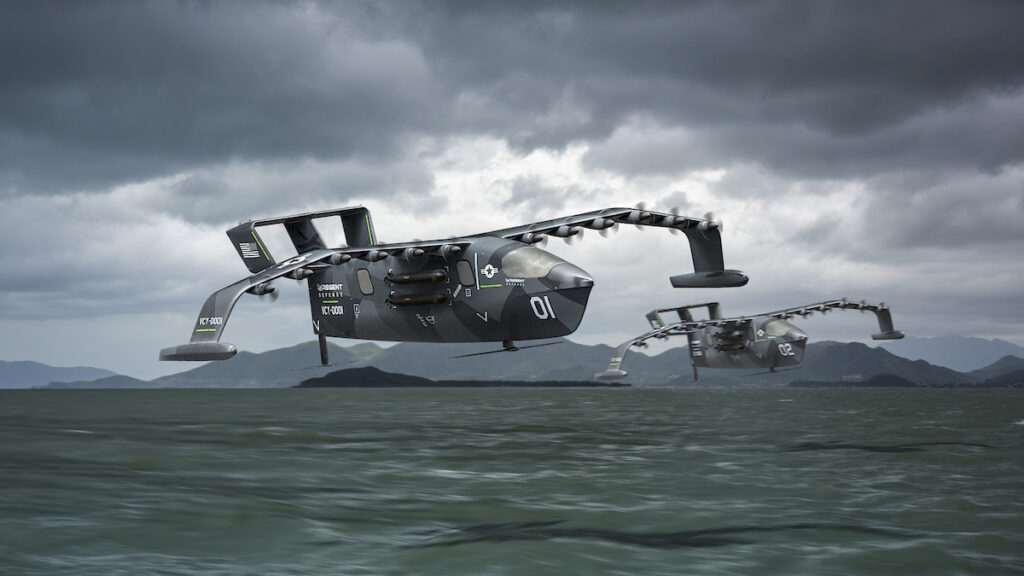
REGENT Craft has revealed a new product line of maritime Seaglider vessels for military applications under “REGENT Defense” at the Reindustrialize summit in Detroit.
In addition to REGENT’s $10 billion commercial backlog, the company will manufacture REGENT Defense Seaglider vessels at its headquarters in Rhode Island to support the U.S. and its allies in countering growing maritime threats.
REGENT’s proprietary hydrofoiling wing-in-ground-effect (WIG) Seaglider design offers a combination of high-speed, long-range, and low-signature capabilities, all at significantly reduced costs compared to legacy transportation solutions. These advantages directly address operations where resupply and transport across vast ocean stretches has historically been difficult.
Billy Thalheimer, Co-Founder and CEO of REGENT, commented, “REGENT is proud to be a dual-use company, and we’re committed to advancing our REGENT Defense work to equip the American warfighter with an urgently needed mobility solution that gives the U.S. and our allies a strategic edge. At the same time, we’re helping to revitalize American manufacturing by building these vessels here at home, creating high-tech jobs and restoring American competitiveness on the global stage.”
Defense Missions
As a Type A WIG craft, Seaglider vessels operate exclusively over water within a wingspan of the water’s surface, benefitting from the aerodynamic efficiencies of ground effect and remaining above sonar and below radar. This highly efficient, agile, and low-signature design allows Seaglider craft to service a wide range of maritime defense missions, including:
- Troop and supply logistics
- Medical evacuation (MEDEVAC) and search and rescue
- Intelligence, surveillance, and reconnaissance (ISR)
- Launched effects, including deployment of uncrewed systems from the Seaglider vessel
Tom Huntley, General Manager of REGENT Defense, added, “We’re building platforms engineered for maritime defense operations in contested and logistically complex maritime environments. Their unique combination of speed, range, and low signature enables mission success while providing a low-cost, scalable solution to deter conflict and enhance operational readiness.”
New Seaglider Solutions
REGENT Defense is building a defense version of REGENT’s commercial all-electric, crewed Viceroy model, as well as a line of fully autonomous Viceroy vessels, hybrid versions, and a quarter-scale autonomous model named “Squire.”
The Viceroy Seaglider vessel has a payload of 3,500 lbs and can travel at speeds up to 160 knots (180 mph) for routes up to 160 nautical miles (180 miles) in the all-electric model and up to 1,400 nautical miles (1,600 miles) in the hybrid model.
The autonomous hybrid Squire Seaglider vessel has a payload of 50 lbs and can travel at speeds of up to 70 knots (80 mph) for routes more than 100 nautical miles (115 miles).
Defense Partnerships
REGENT is reportedly a trusted partner of the U.S. Marine Corps, which continues to advance its strategic shift toward distributed maritime operations. In March, REGENT announced a $10 million expanded collaboration with the Marine Corps Warfighting Lab through the second phase of a contract agreement to validate Seaglider use cases across logistics, ISR, MEDEVAC, launched effects, and other mission-critical areas.
In addition to its work with the Marine Corps, REGENT has formalized development relationships with U.S. Special Operations Command (USSOCOM) and the U.S. Coast Guard Research and Development Center, supporting innovation in agile, next-generation maritime mobility.