

Flight Test Progress on ASKA A5 VTOL Full Scale Experimental Unmanned Prototype

The ongoing flight testing has enabled ASKA to perform extensive fine tuning of the flight control systems to improve maneuverability and stability while minimizing the influence of ground effects By Joe Macey / 28 Aug 2024
Follow AAMi

ASKA, developer of the ASKA™ A5 roadable electric-hybrid VTOL aircraft, is successfully progressing through its tethered unmanned flight tests with its full-scale prototype.
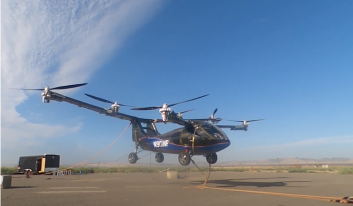
The tethered unmanned flights took place in a private airfield in California. Since the renewal of the special airworthiness certificate in July 2024, A5 performed unmanned tethered flights at a low altitude while loosely tethered to the ground. During the flights, ASKA engineers measured flight and system parameters to verify thrust, flight control, electric and thermal system performance, to include vibration and temperature parameters.

The ongoing flight testing has also enabled the company to perform extensive fine tuning of the flight control systems to improve maneuverability and stability while minimizing the influence of ground effects. To date, ASKA has conducted over 350 successful tethered flight tests.

The ASKA A5 prototype received its initial special airworthiness certification in July 2023. Under its current special airworthiness certificate and its certificate of waiver or authorization (COA), the A5 will fly untethered up to 200 ft above ground level (AGL), as well as being capable to perform vertical takeoffs and landings, and hovering. The completion of these flights will be Stage 1. Conventional flight, and transitioning from vertical to horizontal flight, will follow after the completion of Stage 1 of flight testing.

In addition to flight testing, the ASKA A5 prototype has successfully completed more than 500 miles of road testing (A5 is the size of an SUV in Drive Mode), as well as completing “Drive to Flight” transition testing while on the ground.

The four-seater ASKA A5  makes maximum use of existing infrastructure, such as charging stations, airfields, helipads and runways, and can operate with today’s infrastructure. The A5 also offers the “first and last mile transportation,” enabling it to seamlessly integrate into existing air and ground infrastructure.

Posted by Joe Macey Joseph Macey is a Content Specialist at Advanced Air Mobility International, focusing on emerging aviation technologies since joining in 2022. He has particular expertise in eVTOLs, vertiports, and propulsion systems. A graduate of Falmouth University in Journalism, Joseph began his career in 2019 as a local reporter. His journalism experience sharpens both his reporting and interview skills, enabling him to deliver well-informed, authoritative insights on the latest trends in the aviation sector. Connect

Latest Articles

TCab Tech & CSS Partner to Build Simulation Ecosystem for E20 eVTOL

Strategic collaboration aims to accelerate airworthiness certification and pilot training through high-fidelity simulation technology

Jan 14, 2026
Archer & NVIDIA Partner to Advance Physical AI in Aviation

A new collaboration between Archer and NVIDIA will apply the IGX Thor platform to develop physical AI systems designed to improve aviation safety, airspace integration, and future autonomous flight capabilities

Jan 13, 2026
Skyports Infrastructure & Linden Airport Services Partner to Modernize Miami’s Watson Island Heliport

A historic aviation site is set to become a primary hub for electric vertical take-off and landing aircraft in South Florida

Jan 12, 2026
Joby & CAE Deliver Advanced Flight Simulators to Prepare for Commercial Air Taxi Launch

High-fidelity training infrastructure moves toward FAA qualification as Joby scales pilot pipeline for 2026 operations

Jan 09, 2026
Skyfly & Myriad Unveil VR Motion Simulator for eVTOL Development

New mobile flight simulator from Skyfly utilizes real aircraft fly-by-wire architecture to provide high-fidelity motion cueing and virtual reality training

Jan 07, 2026
EHang Pilotless eVTOL Completes Cross-Province Flight

A successful 18-minute crossing of the Qiongzhou Strait demonstrates a 70% increase in travel efficiency compared to traditional ferry routes

Jan 07, 2026