

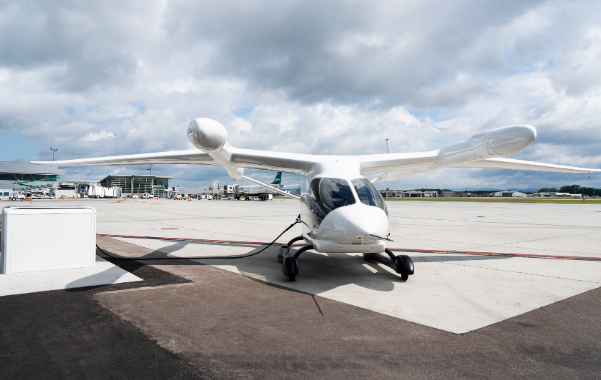
Atlantic Aviation and BETA Technologies are collaborating to install BETA’s electric charging stations at several of Atlantic’s airport locations across the East and Gulf Coasts.
The two have already installed one multimodal, interoperable charger – at Elmira Regional Airport – and have signed host site agreements (HSAs) for three additional locations, with more sites in the works.
BETA’s chargers are designed to be multimodal and interoperable. They utilize a standard that is compatible with BETA’s own all-electric ALIA aircraft and other top original equipment manufacturers (OEMs) across the industry, as well as electric ground vehicles, offering a single solution for ground- and air-based electric transportation alike. As airports and the broader transportation sector continue to transition to electric and sustainable alternatives, this technology provides an important foundation for integrated operations.
“We are thrilled to work with BETA as we look to innovate in the aviation infrastructure space and expand the availability of electric aircraft charging for the market,” said John Redcay, Atlantic Aviation Chief Commercial and Sustainability Officer. “We are focused on a technology-agnostic approach to electrification and new aviation technologies and see BETA’s chargers as a key piece of that story.”
“As a premier FBO company, Atlantic Aviation has a strong pulse on the needs of the market and a long history of innovating to meet demand,” added Nate Ward, BETA Technologies Head of Charge Network Development. “Over the past several years, BETA has been focused on deploying a reliable, well-distributed network of fast chargers to enable the entire advanced air mobility industry, and we are aligned with the team at Atlantic on our mission. This collaboration represents an important step in growing a network across North America, and we look forward to working together to bring this vision to fruition.”
The parties have infrastructure in the ground or HSAs in place for Birmingham International Airport (BHM), Elmira Regional Airport (ELM), Jackson-Medgar Wiley Evers International Airport (JAN), and Westfield-Barnes Regional Airport (BAF), and are actively working with additional airport authorities to continue their collaborative expansion. These Atlantic sites will join BETA’s growing network of charging stations across the U.S. The company has brought its multimodal and interoperable chargers online at 17 locations, with another 55 sites in the permitting or construction process.
In addition to implementing future-focused infrastructure that will enable AAM in key regional markets along the East and Gulf Coasts, Atlantic and BETA have developed a model approach for the industry. With this agreement, they have created a template for FBO OEM relationships that will expedite the execution of HSAs moving forward, allowing for expanded infrastructure implementation as the industry readies itself for projected 2025 AAM operations.
The existing network, which spans from Vermont to Arkansas and Florida, includes the Department of Defense’s first-ever electric aircraft charger installed at Duke Field, Eglin Air Force Base, where BETA’s ALIA aircraft was deployed for several months. Many of these sites have been tested first-hand by BETA’s all-electric ALIA aircraft as it has traveled from Burlington, Vermont to Bentonville, Arkansas, Louisville, Kentucky, and Eglin, Florida, respectively.
Together, Atlantic and BETA are creating greater access to electric aviation which, with its reduced costs and net-zero operating emissions, will enable regional air mobility, unlock new mission sets and network configurations, and allow for the reconnection of communities.